Defining Risk Video

Many people are talking about risk in a way that has nothing to do with what is at stake.  The myRA  bond introduced by President Obama at his state of the union address is the latest example.  This 3 minute video is my explanation of what is at stake. The 2nd video is a 4 minute video on Portfolio Navigation.  The 3rd video is an interview with the former CEO of The City and County of San Francisco Retirement System and an interview with professor Sam Savage of Stanford University.  The full 30 minute video that covers the research findings of the past 30 years is available at the KMVT link below the interview video.


Posted in Uncategorized | Leave a comment

Portfolio Navigation Update

Dr. Frank Sortino discusses a better way to make asset allocation changes than either rebalancing or LDI. (SEE Also November 2012 under Archives)

This is a 5 minute clip from a 30 minute video produced at KMVT Studios in Silicon Valley. (For the full video0 (Click on  KMVT Channel.)

Isn’t this just like…(insert phrase) is what we often say when someone describes something new to us.  No doubt Einstein heard, “isn’t that just like Newtonian physics”? when he presented e = mc2 .  After all, physics is physics.   At a much lower level of complexity, we have heard some comparisons that need clarification.  The video explains how Portfolio Navigation is different from rebalancing and LDI but it does not address two other faulty comparisons.

  1. Isn’t this just another form of momentum investing?  Perhaps the most notorious form of momentum investing was called Portfolio Insurance, developed by two professors at U.C. Berkeley.  It involved a mathematical formula for increasing equity exposure as the market went up and decreasing exposure as the market went down.  Yes, Portfolio Navigation does involve mathematics but the underlying methodology seeks to do quite the opposite, i.e., a large rise in the market will cause the DTR to decrease, thus decreasing equity, because you will then need a lower rate of return to achieve your desired pay out.  Whereas Portfolio Insurance failed in 1987 because they were trying to unload positions as the market crashed, Portfolio Navigation would be increasing equity exposure after a decline sufficient to increase the DTR.  The market place could not accommodate all sellers and no buyers but it would have welcomed our buy orders.

 In the study performed ex ante at P&I magazine in 2000 the high tech mutual funds of 1998 were replaced by  large cap value and Income and growth funds.  With the CIFs managed at Fiserv , the change in the UP ratio and DTR alpha resulted in a decrease in equity in mid 2007.

  1. Isn’t this just doubling down?  A strategy in the Black Jack card game calls for doubling your bet when you lose as a way to recoup losses.  Yes, Portfolio Navigation increases equity exposure as the portfolio value declines,  but only enough to get back on course to obtain a DTR  needed to achieve your desired payout.  Doubling the equity exposure would be a crude and foolish strategy.
Posted in Uncategorized | 2 Comments

PMPT Interviews with Clare Murphy and Dr. Sam Savage

This video is another clip from a half hour program produced at KMVT in Silicon Valley. The clip is an interview with the former Executive Director of the City and County of San Francisco Retirement System, Clare Murphy; and Dr. Sam Savage from Stanford University.
The important thing to take away from my interview with Clare is the changes she introduced during her 25 year tenure as CEO. As the assets under management grew from $600 million to $16 billion the use of outside active managers grew from approximately 10 to 40 managers. This constituted about 80% of the AUM. This is contrary to the view that the more money one has the more you rely on passive indexes. Clare was on the cover of Institutional Investor Magazine in 2005 and was semi finalist for public fund of the year award.
Sam has written an excellent book titled, The Flaw of Averages. It is the best book on interpreting statistics I have read, and it is written for practitioners, not statisticians. Sam mentions the work of Bradley Efron who received the National Medal of Science award in 2007 for his bootstrap methodology. The National Medal of Science is an honor bestowed by the President of The United States on those who have made important contributions to the advancement of knowledge in the sciences.
Sam says, Efron is one of those rare individuals who straddle a technological divide. Schooled in classical statistics, he inspired a revolution that supplanted it. Efron’s work has been critical to my own. I believe it is a quantum leap forward from what currently passes for estimating “the shape of the future “ Sam describes and what I call the shape of uncertainty.
If you would like to see the complete video go to the KMVT Channel.

Posted in Uncategorized | Tagged , , | Leave a comment

It’s Called Portfolio Navigation, Stupid

Below is the posting we made on April 21, 2013. It provides the underlying principles of this approach to portfolio management.  An empirical investigation conducted for a DB plan titled “Portfolio Navigation for DB Plans” was published on this site on March 11th, 2015.  A video on Portfolio Navigation is available on the right side of the opening page of this site.  It is the basis for my calling for increasing the current allocation to equities. Other examples were given in my books.

PORTFOLIO NAVIGATION HISTORY

A new approach to guiding portfolios through storms in financial markets.

A brief history of navigation:
The magnetic compass was first invented by the Chinese in AD1080 but it was not used for navigation until AD 1111. Knowledge of the direction pointing North made it possible to estimate the direction one was heading. That was useful when a ship was leaving the harbor, but useless when one was out of sight of land. Until the 17th century sea captains relied on guesses about the currents, winds and speed to estimate their location. This was called, “dead reckoning”, probably because it often marked the crew for dead if the estimates proved wrong.
Due to coastal fog, many ships missed the harbor entrance to London and ended up on the rocks. This caused the King of England to offer the equivalent of a million dollars to the man who could solve the longitude problem. Everyone knew how to obtain their latitude, so knowing the longitude would fix their location where the two lines crossed. In 1736 an unknown amateur watch maker created a watch that solved the problem. Unfortunately, he lacked any formal training in watch making as well as any academic credentials, so his solution to the problem was blocked by the learned establishment for the rest of his life. The result was, John Harrison died a pauper and many lives were lost unnecessarily.
When I was in the U.S. Air Force, navigation training still began with dead reckoning and every flight plan began with estimates of the winds aloft, the lines of magnetic variation we would cross and our planned airspeed, all of which never proved correct. So the essence of navigation remained the same: determine your current location periodically and plot a new heading to your destination. It would have been unthinkable to “stay the course” in hopes that friendly winds would blow you back on course.
Portfolio navigation:
I believe the basics of navigation apply to portfolio management. If we view the client’s portfolio as a vehicle that needs to be navigated through financial markets, wouldn’t the return needed on the portfolio be akin to the heading the portfolio manager needs to steer in order to reach the planned destination? We call that heading the Desired Target Return® or DTR®. And if financial storms blew the portfolio off course, wouldn’t the ability to plot a new DTR to the desired destination be preferred to “staying the course?

This view challenges the basic assumptions about why people invest and how best to manage those investments. Portfolio Navigation assumes people are trying to get from where they are financially to where they need to be at some specified time in the future. More specifically, they want to reach a financial goal that provides a certain payoff that will achieve the goal. If a 401(k) investor wants to replace 70% of salary at retirement, doesn’t that define the goal and allow a reasonable estimate of where the portfolio needs to be in order to make that payout at retirement? Viewed as a navigation problem, would it make sense to put an investor in one portfolio until retirement and say, “just stay the course and maybe you’ll get there”? Only if one has no knowledge of portfolio navigation.

Just as the compass was the beginning of the science of navigation, Modern Portfolio Theory was the beginning of a new science of portfolio management. Portfolio Navigation provides a way to use the compass, along with the equivalence of longitude and innovations in equipment, to navigate the financial markets of the world and bring the portfolio safely to its desired destination. We hope this will prevent many portfolios from ending up on the rocks.

Posted in Uncategorized | Leave a comment

Real Engineering versus Financial Engineering

Here are two clips from e-mails I have received. The first is from a leading European University that teaches financial engineering. The second is from the prospectus of a fixed income mutual fund company. The first is a theoretical argument. The second is a CYA disclaimer statement.

FirstClip

SecondClip

Ever since the CAPM claimed that it was less risky to borrow money and invest it in the market portfolio than invest in a portfolio on the efficient frontier that lies below the security market line, both academics and practitioners have argued that leverage and going short are beneficial strategies for investors. Of course, the CAPM assumes there is such a thing as a risk-free rate and investors can lend and borrow at that rate, plus a few chapters of additional assumptions. Financial engineering is the latest development in this theoretically correct but practically wrong ruse. I am not opposed to the use of derivatives to alter the risk-return characteristics of portfolios but we need to keep in mind that engineers build real things and we build paper things that do not hold up unless a lot of assumptions prove to be correct. The misuse of financial instruments is not solely responsible for the financial collapse of 2008 but is certainly not blameless and does need to be regulated, not eliminated, to prevent future avoidable calamities.

I agree with professor Ducoulombier-investors should be fully informed of the risk-return characteristics of esoteric strategies. The investor should be entitled to the same disclosure protections by the SEC as the FDA provides to consumers of medications. For example:

  1. The investor should be told the percentage of the portfolio in derivatives, the resulting leverage and the effect that could have on losses, fees and expenses.
  2. An explanation of the assumptions being made should include examples of the consequences if those assumptions do not hold and a record of past occurrences.

“Order is indeed the dream of man, but chaos, which is only another word for dumb, blind, witless chance, is still the law of nature. You can plan all you want to but… “ Wallace Stegner

We are told that there is nothing to fear now. The fiscal cliff….a thing of the past. The sequester disaster….came and went. To paraphrase Stegner, never underestimate Govertment’s ability to make dumb, blind witless decisions that will upset the plans of learned men and women.

The flaws in our global financial system have not been corrected. That’s a shark that is still swimming out there in our sea of contentment. The promises of Governments, businesses and theories to transform our world of uncertainty into something we can count on have been proven unreliable. That pension benefit you were promised….here’s your 401(k), lots a luck. Remember this: we live in a world of uncertainty. There isn’t any knowing what is going to happen. But, there is a professional way to manage that uncertainty that might tilt the odds in your favor. That’s as good as it gets.

So, what are we professionals to do for those who put their trust in us? DON’T LET THEM SWIM WITH SHARKS! Make them stay in unleveraged shallow water. Don’t let them go beyond the diversified reef that provides some modicum of protection. Chasing the next Google will attract sharks.

Posted in Uncategorized | Leave a comment

The Glidepath Obfuscation

Much attention has been given to the matter of the proper glidepath for 401(k) participants.  Most recently Rob Arnott, founder of Research Affiliates, has weighed in on this subject.  Arnott’s criticism of any mechanistic glidepath,[1] was in turn criticized by Steven Wallman[2] for missing the point that a glidepath reduces risk.   Arnott then accused Wallman of missing the point because “the numbers are what they are” and the numbers show a reduction in return that offsets the reduction in risk.  Well, Arnotts contrived numbers may show that but in my opinion, they are both missing the point.  To paraphrase Einstein, they are trying to solve today’s problems with outmoded methodologies of the past.

The main flaw in their logic is that both of them choose to ignore the return that each 401(k) participant needs to earn on their assets in order to meet a future payout, namely, retirement income. Both gentlemen choose not to estimate this return that we call the Desired Target Return® or DTR®.  Ipso facto, ignoring the DTR makes it impossible to calculate the risk of falling below the DTR or the potential to exceed that return.  In other words, they have identified the wrong problem which leads to the wrong solution to the real problem.

Framing portfolio management as an asset management problem leads both men to focus on which assets to use to achieve the highest terminal wealth.  Wallman says young people should start out with stocks and end up in bonds to reduce the risk of a hit to terminal wealth.  Arnott says investors would more often have ended up with greater wealth if they started out with bonds and ended up in stocks.  We agree with Wallman that 401(k) participants who wanted to retire in 2008 should not have been heavily weighted in stocks in 2007.  We also agree with Arnott that age alone should not determine the asset allocation between stocks and bonds and starting to decrease equity 20 years before retirement is ridiculous.

But gentlemen, investing is an asset-liability management problem, not an asset management problem.  Stocks and bonds are only the vehicles we use to get investors from where they are financially to where they need to be at some point in the future.  Your argument is as foolish as debating whether or not people should begin every trip by air or by bus.  The proper combination and timing of vehicles depends on where they are going and where they are starting from, not on their age or their preferences.

Lest we be misunderstood, we have the greatest respect for Rob Arnott and his understanding of financial theory.  He was, after all, the editor of the Financial Analysts Journal.  But let’s see how his adherence to the MPT framework leads him astray as regards a much needed solution to managing 401(k) plans for participants.

Critique:

  1. Arnott uses 141 years of stock and bond market returns to make the case that “Prudent Polly”, who begins at 22 years of age with an 80% equity position and at age 30 begins her descent in equity until age 63, at which time, she liquidates her portfolio and purchases an annuity with the funds she has accumulated.  With 20/20 hindsight he shows she could have done better by maintaining a 50/50 mix of stocks and bonds or steadily increasing equity exposure.  This implies history is going to repeat itself, an assumption he later decries.  We believe Bradley Efron’s “Bootstrap” procedure is a superior way to describe future return distributions and provide evidence in our paper titled, “Portfolio Navigation”  that a glidepath longer than five years is like starting your descent into Kennedy Airport when you are over Chicago.
  2.  Arnott uses three measures of risk to make his point: the standard deviation of returns for the past 141 years, the range of returns from the 10th percentile to the 90th percentile and the ratio between the 10th and the 90th percentiles.  However, none of these risk measures incorporate the return Polly needs to earn in order to replace a predetermined percentage of salary. Furthermore, we have shown that reliance on the probability of a low return for capturing the risk that Polly is facing is inadequate and misleading.[3]  The disastrous results of using Value at Risk (VAR) in 2008 testify to that.   We believe a relevant measure of risk should capture the risk of not achieving the retirement income she needs and propose deviations below her DTR as a more appropriate risk measure.
  3. Arnott then says it is much more important for Polly to know “how large a lifetime inflation-indexed annuity she can buy at retirement” because that is “an important measure of success.”  In other words, Polly is stuck with whatever amount of money she is lucky or unlucky enough to accumulate at retirement, because nobody bothered to estimate how much she would need to replace, say, 70% of her salary at retirement.  This implies the goal is to make as much money as she can.  We believe the goal is to replace 70% or more of her income and the way to measure that is to estimate the potential to exceed her DTR.
  4. Arnott then calls attention to his assumption that she was only saving $1000 per year and nothing can make up for investing too little too late.  We agree, but believe an appropriate methodology would notify her periodically how much more she needs to invest, as we do in our Mapvest® report.
  5. Arnott then attempts to correct for assuming the past is prologue by randomly drawing annual returns from the 141 years of annual returns to generate a better picture of uncertainty.  However, first he attempts to make the outcomes look more like today’s by assuming “ risk in the future resembles the past but returns in the future are lower.”  This ad hoc adjustment seems to imply his methodology is flawed. Furthermore, only selecting annual returns that did happen cannot account for what has never yet happened.  But the bootstrap procedure does address this without subjective adjustments.  We believe the methodology we used in our paper “Portfolio Navigation™” is a superior way to compare strategies and leads to a more reliable way to manage Polly’s portfolio over time.

Summary and conclusions:

Instead of framing portfolio management as an asset management problem where the solution is to maximize wealth and whoever makes the most money wins, we believe one should frame it as an asset-liability management problem.  From this perspective, the solution more closely resembles a navigation problem that will transport Polly’s portfolio from where it is to where it needs to be at some specified time in order to meet or exceed an estimated payout schedule.

Bickering over trivial matters like the glidepath only serves to obscure the real problem.  Target date funds are a dismal failure, yet the most popular choice for defined contribution plans.  Therefore, instead of trying to fix a seriously flawed methodology, we should all work to scrap it for a superior approach oriented toward accomplishing the investor’s real goal of replacing income at retirement.  Making money is not the goal in and of itself.  Making money is how one accomplishes the goal of meeting or exceeding some specified future payout. How much money is needed and how much risk is involved can only be determined if one bothers to estimate the DTR. This is a critical variable that should no longer be ignored.


[1] RA Fundamentals, September 2012

[2] www.fa-mag.com, November 19,2012

[3] The Sortino Framework for Constructing Portfolios, pg 27.

Download this post as a pdf:  The Glidepath Obfuscation

Posted in Uncategorized | Leave a comment

A Solution to the Discount Rate Fallacy

The key pad is mightier than the pen. 

Because we don’t know what is going to happen in a world of uncertainty we make assumptions.  That is reasonable and rational behavior.  Then we start treating those assumptions like facts and therein lies the problem.

President Obama has just signed the Highway Investment, Job Creation and Economic Growth Act of 2012 that will increase corporate earnings, increase taxes and decrease pension liabilities.  All this, with a stroke of the pen that simply changed the assumed discount rate from 2.56%  to 5.59%.  Another short term fix to a long term problem.

What this points out to me is the fallacy of using an assumed rate to determine how to properly manage a pension plan.  The actuary uses a highly sophisticated computer program to solve for the liability stream of payouts for the next 30 years or so.  The present value of the assets is known with certainty…well, excluding the illiquid assets lurking in the portfolio.   

What pension plan sponsors should demand is that actuaries SOLVE for the internal rate of return (IRR) that discounts the expected payouts to the present value of the assets.  This would be a meaningful number that would allow the plan sponsor to use a more realistic estimate of the rate of return needed in order to meet the projected liabilities.  Actuaries can do this with a stroke of the key pad on their computer and that will be an antidote to the illusion that the pension plan is funded when it is not.  It will also allow the consultant to measure risk relative to that IRR instead of to some market index that is totally unrelated to the liabilities.

Posted in Uncategorized | Leave a comment

Evidence Trumps Emotion

Evidence Based Management Revisited

Dr. Frank A. Sortino, Founder & Director of PRI

Since 1981 The Pension Research Institute (PRI) has been providing evidence that Post Modern Portfolio Theory (PMPT) is a better way to construct and manage portfolios.  In chapter 6 of my first book my colleague, Dr. Joseph Messina pointed out how value at risk (VAR) was inappropriate for risk averse-investors.  This was particularly true for those who view risk as the failure to earn a specific return needed to achieve their financial goal, like replacing a percentage of their income at retirement.

Now, Professor Savage at Stanford University in his book, “The Flaw of Averages”[1]provides further evidence on the shortcomings of standard deviation and makes some interesting observations on decision making under conditions of uncertainty.  In Chapter 24 he cites two  approaches to help investors manage risk.  The first approach was used by the $50 billion Bessemer Trust which presented four portfolios with 0%, 50%, 70% and 100% equity exposure.  The remainder was invested in bonds.  Risk was measured as the worst outcome experienced over different periods between 1946 and 2005.  The worst 5 year period for the 100% fixed income portfolio was -2.1% while the worst 5 year period for the 100% equity portfolio was only -.8%.  Lest you conclude bonds are riskier than stocks, the worst 1 year interval for the 100% equity portfolio was -25.6%.

This provides evidence that a five year glide path was sufficient for 401(k) participants even if they were 100% in equity during crises like the Korean War, the Cold War, the Cuban Missile Crisis and Viet Nam.  Politicians and consultants would be wise to buy Stanford Professor Jeffrey Pfeffer’s book on evidence based management (visit www.evidence-basedmanagement.com)  so they could stop relying on their emotions and start looking at the evidence before making misguided decisions that make it more difficult for working class citizens to retire with dignity.  Forcing 401(k) participants to exit from equities 10 years before retirement is like pilots beginning their approach to JFK when they are over Chicago.

The second approach mentioned by Professor Savage is the Financial Engines 401(k) service.  In this case, the participant goes to the Financial Engines website to run a computer program that generates a probability distribution of possible outcomes based on economic scenario forecasts and choices of assets from a database of thousands of managers.  The output is pictures of weather forecasts ranging from stormy to sunny skies that depict the chances of replacing various percentages of income at retirement.

So, what’s wrong with that?  The same thing that is wrong with asking someone who has never flown to take over the airplane and land it at JFK.  THEY ARE NOT QUALIFIED!  Investing is not easy and any attempt to make it appear so, is at minimum misleading, and possibly inviting portfolio suicide.  Before asking a 401(k) participant to construct a suitable portfolio and manage it through all kinds of financial storms they should require an answer to the following question: How many people do you know that would pay you to manage their portfolio?  If the answer is zero, the computer should blast out, “THEN WHY WOULD YOU HIRE SOMEONE THAT NO ONE ELSE WOULD HIRE”!

If the government really wants to protect investors from incompetent management they should begin by discouraging do-it-yourself programs and encourage investors to seek the best professional Financial Advisors they can afford.


[1] Available on Amazon.com or  www.FlawOfAverages.com

Posted in Uncategorized | 1 Comment

Some Thoughts on Volatility Strategies

This is a critique of a front page article in Pensions & Investments on April 16, 2012 and an Investment News article about Dr. Robert Haugen’s strategy.  It seems all one needs to know is what the volatility WAS of a stock or a manager or a portfolio and one can pick the stocks that will outperform all others, the manager who will beat all others and last but not least, the asset allocation strategy that would have done best in the past.  That’s right!  It is all based on the standard deviation of historic returns over some brief period of time.  Many studies have shown that a time series of historic returns tells you nothing about future returns.  But now we are told the standard deviation of those returns can predict future outcomes.  Therefore, all you need is a hand held calculator and Voila, you are a portfolio manager.

Well let’s see.  Table 1 shows the historic returns on two managers.

Table 1
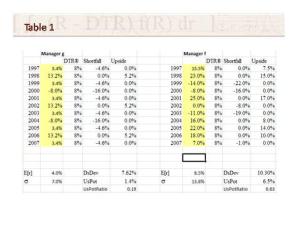
Which manager should you hire? The new volatility theory says to choose the one with the lowest standard deviation.  Yes, it has a lower expected return, but that doesn’t matter because this is supposed to predict the winner, not the expected return.  You will notice that the mean is an arithmetic average and as Einstein said, it is the geometric average that is most powerful. The standard deviation captures the risk of not achieving the expected return.  We do not believe that is what is at stake.   More importantly, the mean and standard deviation ignore the return one has to earn on assets in order to meet some future pay outs, like retirement benefits.  We call this link between assets and liabilities the Desired Target Return® or DTR®.  So, we believe the mean is the wrong focal point and deviations about the wrong focal point have nothing to do with the risk of not achieving the DTR needed to accomplish your goal.

However, maybe by plotting the returns of managers g and f (see Figure 1) it will be easier to see what the value is of the low volatility strategy.   
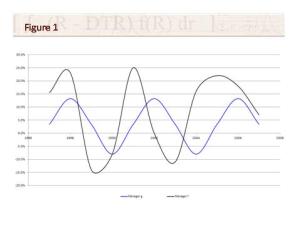
Hmmm, the black line does go up and down more so it must be more volatile.  But why is that, in and of itself, important?  Are we now to ignore the concept of a risk-reward trade off and look only at the wrong risk component?  The theoretical foundation of this strategy is still not clear to me.  Maybe that is because it has no theoretical foundation.  Let’s recast these returns in terms of Post Modern Portfolio Theory[i] (PMPT).

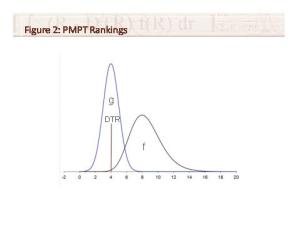
Figure 2 uses the bootstrap procedure of Bradley Efron at Stanford and the three parameter lognormal of Aitchison and Brown at Cambridge to obtain a forecast of what could happen in the future.  This forecast is based on what could have happened, not just what did happen, in the past.  This has been tested at the Pension Research Institute in a project with Dr. Robert van der Meer when he was at Shell Oil, Netherlands.  Based on this evidence we believe it is a superior way of estimating what could happen than simply calculating the first and second moments from a time series of historic returns.

Figure 2 shows that the distribution of returns for manager f  is mostly to the right of manager g.  Therefore, f dominates g by 2nd degree stochastic dominance rules (SSD).  We mention this only as evidence that there are more rigorous ways of ranking   But you don’t have to understand SSD to see that anyone who has to earn 4% or more (DTR = 4%) would prefer f regardless of his or her risk tolerance.  Just look at how much of the distribution of g lies below the DTR.  Half of it, as opposed to a tiny bit of distribution f.
Well, making investment decisions based solely on the probability of a good outcome relative to the probability of a bad outcome is really dumb.  The probability of your parachute not opening if you jump out of an airplane is very small.  But if it doesn’t open, the magnitude of pain you will suffer is not captured by the small probability.  How many times have you heard of a financial disaster that had only a small chance of occurring?  So, both the upside and the downside should have a magnitude factor as shown in Figure 3. 
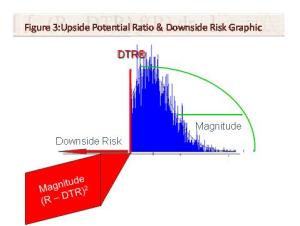
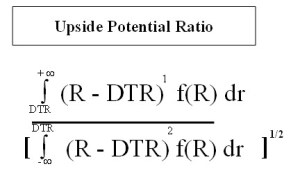
The probability of exceeding the DTR is shown in blue but the upside potential has a magnitude factor that extends to the green arc.  This implies, getting 2% more than your DTR is good but getting 4% more is twice as good.  On the other hand, returns below the DTR are squared so that 2% below becomes 4% and 4% below becomes 16%. The equation for the upside potential ratio is shown in Figure 4.

Notice that the denominator is anchored 3 standard deviations below the lowest return that occurred in the bootstrap procedure.  Yes, we use standard deviation where appropriate.  Every distribution has one.  But every distribution does not have a DTR until you calculate it and put it there.
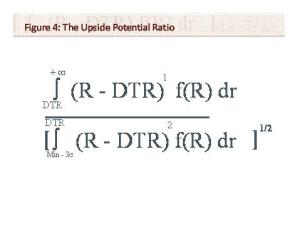
Is there a theory to support this calculation?  Yes, it is called Behavioral Finance[ii].  Our good friend Hersh Shefrin at Santa Clara University told us about studies claiming that investors don’t discuss their preferences in terms of mean and standard deviation.  Instead they say they want upside potential and downside protection.  The equation for the Upside Potential Ratio that we developed with our colleagues at Groningen University was published in the Journal of Portfolio Management.

Has there been any rigorous testing of this approach to forecast future outcomes?  Yes, Figure 5 presents the results of a study performed by Bernardo Kuan when he was at the Pension Research Institute.[iii]
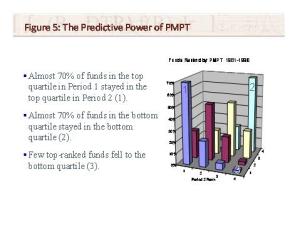
We believe this is a very impressive study of predictive power.  You may do better for awhile using a simple heuristic rather than PMPT.  But some day, if your supposed theory doesn’t work, you may have to explain to someone why you never bothered to calculate the return on assets needed to accomplish the investment goal.  This reminds me of the American doctors in the late 1800’s who didn’t think it was necessary to wash their hands and sterilize their equipment before an operation.

Finally, as a response to Mr. Taliaferro at Acadian who wrote, “Because risk is measured on a relative basis, a portfolio that moves up and down less than its benchmark is perceived as more risky on a relative basis because it is considered less correlated,” we offer the following:”

Figure 6 shows a highly volatile asset f relative to two low volatility assets, g in blue and series 3 is shown in green.
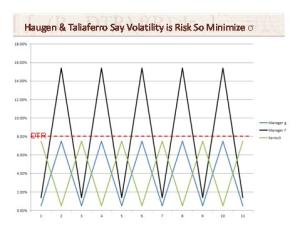
Notice g (blue) is positively correlated with f and series 3 (green) is negatively correlated with f.  We submit to you that an investor who needs to earn a DTR of 8% would prefer asset f to either g or series 3 because g and series 3 never achieve the 8% DTR® while f achieves 8% on average.  Furthermore, if you offer them a portfolio of g and series 3, which are perfectly negatively correlated and therefore produce a supposed risk free rate of 4%, they may ask you, “how is it risk free to constantly earn 400 basis points less than I need?”

End Notes:
[i] For the foundations of this theory see, “Managing Downside Risk in Financial Markets”, and “ The Sortino Framework for Constructing Portfolios” on Amazon.com.

[ii] See page 7 of  “The Sortino Framework for Constructing Portfolios.”

[iii] See Chapter 3 in  “The Sortino Framework for Constructing Portfolios.”

Posted in Uncategorized | Tagged , | Leave a comment

PMPT Marries Prospect Theory

Introduction:

 Believing in a theory as evidence mounts disproving its merits will lead at first to disappointment and then to a better theory.  Concocting a strategy that solved the previous market fiasco without any theoretical foundation will lead nowhere.  All will soon discover you never believed in anything except making money…for yourself.

After 12 years of chasing various strategies to dead ends, I returned to academia for nine years to learn what there was to know about managing uncertainty in financial markets.  I believe theories provide a belief system that serves as an aid for getting the job done and the job is to help investors accomplish their financial goals.  We must remember that theories are beliefs based on assumptions, not facts and when you start treating assumptions as facts you are in big trouble.  Still, a theoretical foundation is better than a “get a hunch bet a bunch strategy.”

The key, I believe, is to maintain a questioning mind.  The idea that we should not act in the best interests of investors because it calls into question some theory we believed, or that it contradicts something we said in the past, is egocentric nonsense.  There was a time that I believed the Sortino Ratio was the best way to measure performance.  When the evidence began to accumulate in the 1990’s that I was wrong, I wrote a paper pointing out the flaw and posted it on my website.  Then I began work on a better measure.  I didn’t wait for the new “upside potential ratio” to be developed and tested before discarding a flawed statistic.  Those who continue to use it do so because it makes their performance look better than they are.[1]

In chapter 26 of “Thinking Fast and Slow” Daniel Kahneman points out some of the flaws in Prospect Theory, starting with when the reference point is assumed to be zero   He goes on to say,  “Prospect theory has flaws of its own, and theory induced blindness to these flaws has contributed to its acceptance.”  That led him to posit a two system approach to understanding the decision making process of human beings.  System 1 deals with intuitive responses that are automatically and effortlessly arrived at.  System 2 is concerned with the deliberate and effortful mental activities associated with quantitative reasoning.  I like to think of our approach to investing as being associated with System 2.

Kahneman worked closely with Amos Tversky to develop  a body of work that came to be known as behavioral economics.  Dr. Hal Forsey and I have worked closely for many years to develop a body of knowledge that has come to be called post modern portfolio theory or PMPT.  I was a professor of finance while Dr. Forsey was a math professor.  We tried to find solutions to the biases identified by researchers like Kahneman and Taversky (K&T).  We drew on the research of a number of theoreticians that we examined in order to develop a theoretically based strategy for managing portfolios.  The strategy is called Portfolio Navigation.

The purpose here is to point out how we attempt to incorporate some of the findings of K&T in our strategy.  K&T pointed out that classical utility theory lacks a reference point from which to evaluate gains and losses.  They said the reference point may be an outcome to which one feels entitled (e.g., retirement income).  We call this reference point the Desired Target Return® or DTR®. Returns below the DTR incur risk of not accomplishing the goal.  Returns above the DTR are the gains in excess of what is needed.  Prospect Theory implies losses loom larger than gains.  We agree (see Figure 2).

The S shaped utility function of prospect theory in Figure 1 indicates investors are risk averse to returns above the DTR and become risk takers for returns far below the DTR.

Figure 1

This may well be the way people behave but it is contrary to one of the oldest strategies on Wall Street, “Ride your gains and cut short your losses.”  People like Bernard Baruch used this simple rule of thumb to overcome some of the System 1 responses that Khaneman uncovered.   The foolishness of ignoring a small probability of a disastrous outcome can be illustrated by considering the small probability of a parachute not opening.  Something akin to considering only the probability of a mechanical failure while ignoring the magnitude factor of breaking every bone in your body after plummeting to earth is foolhardy at best and should never be offered to clients as a low risk strategy.

Peter Fishburn proposed the utility function in Figure 2 .  We view it as a System 2 type theory of choice.

Figure 2

 Figure 2 indicates people should figure out what return they need to achieve in order to accomplish some financial goal.  Fishburn called that the target rate of return.  We call it the DTR®.  This seems a more sensible way to behave.  Investors are viewed as risk neutral for achieving returns above the DTR.   They like the notion of acquiring greater wealth than they need; yet they are risk averse to losses that result in failure to achieve their goal.   When Hal Forsey and I built our first optimizer we set the investment objective as, maximize the expected return for a given level of downside risk.

Then I became aware of the behavioral research of Shefrin and Statman at Santa Clara University.  They cited studies that showed what investor’s really want is a portfolio that gives them “upside potential” but protects them against “downside risk.”  However, the studies used only probabilities to measure these concepts subjecting investors to the “faulty parachute” type of reasoning.  Hal and I corrected this error with the following mathematical changes that penalize losses by squaring the differences of returns below the DTR while only taking simple differences for returns above the DTR.

Figure 3

Recent findings in neuroscience provide evidence that a System 2 approach that captures what investors intuitively want but don’t know how to quantify should be superior to asking them to fill out a risk tolerance questionnaire they don’t understand.  It seems that the part of the brain just inside our temples, called the dorsolateral prefrontal cortex is involved with events in the outside world that require explicit, analytic and rule based reasoning.  The part of the brain behind our forehead deals with emotions, whether something is good or bad, and is called the medial prefrontal cortex.  Preference questionnaires require the wrong part of the brain, the emotional part, to deal with events in the outside world (like portfolio management) instead of the rational part of the brain. This led us to develop a new optimizer.

Theory or  Strategy?

 Interestingly, the theoretical differences between Prospect Theory and our approach disappear in our portfolio navigation strategy.  For example, we calculate the DTR as a return that must be earned on the assets in order to meet some future payout or liability.  If market circumstances cause the DTR calculation to change, we change the asset mix of the portfolio.  The result is that after a series of gains that changes the DTR from say, 8% to 6% we reduce the equity exposure to one that is commensurate with a 6% return.  The result is, we are telling the investor to take less risk, which is consistent with prospect theory.  If a series of losses cause the DTR to change from 8% to 10% we increase equity to achieve the higher return.  In effect becoming risk takers after a substantial decline in the portfolio value.

In other words, by framing portfolio management as a navigation problem instead of a wealth maximization problem we systematically change the reference point in prospect theory to achieve a desired outcome.  The result might be said to rationalize what we said previously was an irrational theory.  So what?  So long as it benefits investors we will use it.

Is Portfolio Navigation a theory or a strategy or a theoretically based strategy?  We don’t care.  It is more than just a hunch and we plan to use it…but will keep an open mind for better navigational tools to get investors from where they are financially to where they need to be.


[1] See chapter 3 of “The Sortino Framework for Constructing Portfolios.

Posted in Uncategorized | Tagged , | Leave a comment