
Should The Government Regulate Risk Taking?

How much risk was this woman taking? How would one measure it? There were 40 some people in our group when my wife had this picture taken and nobody got gored. So, was this a riskless transaction? Just because you don’t know how to measure it doesn’t mean it wasn’t risky. That goes for Rhinos and hedge funds and treasuries. Yes, investing solely in treasuries will guarantee failure to produce the needed retirement income for over 90% of retirees. That is a hidden risk. Risk is situation specific and should be related to what is at stake. Default risk is not what is at stake when investing for retirement.

When we check into a hospital we know full well they are full of germs, viruses and sick people. We also know that people are dying every day in hospitals, sometimes from infection but sometimes we hear that the operation was a success but the patient died. Those are the risks that society is willing to take because we all know there would be a lot more deaths and illnesses without them. It is not society’s duty or responsibility to eliminate risk associated with medical care. That risk cannot be eliminated but it can be managed by ensuring that hospitals meet certain standards and that the staff and physicians have the proper credentials. What patients should expect is that the action taken by the physician is consistent with the diagnosis and the diagnosis determines the necessary amount of risk.

Similarly, there is always a certain amount of risk associated with investing money and some portfolios die every year. But those who now want to terminate 401(k) plans and replace them with a government plan that guarantees 4% ignore the relevant risk, that most people will never be able to retire with dignity unless they earn more than 4%. The Government should not attempt to regulate something they are not trained to understand. Removing the tax deductibility of 401 (k) plans for an inadequate guarantee would hurt more hard working investors than the financial crisis of 2008; except that it will take them a lifetime to discover it. The key is to require a professional diagnosis of the client’s needs and investible assets and ensure that the actions taken by the financial advisor are consistent with that diagnosis.

I believe this approach will eventually lead to a more professional way of attending to the needs of investors and the health of their portfolios. Framing all investment strategies as an asset management problem should eventually give way to a framework that recognizes most investments are made for some future payout.
Posted in Uncategorized | Tagged | Leave a comment

Attacking the GIGO Problem

All of us who try to manage uncertainty in financial decisions face the problem of describing that uncertainty.  To the extent that we can improve on the accuracy of that description we can produce better results for our clients.  Professor Emeritus Joseph Messina has done some path breaking work in that regard.  Calibration theory has been shown to improve the forecasts of every manager.  No, it can’t turn a bad forecast into a good one, but it can make it better by employing a quantitative technique developed on the battlefields of Viet Nam. Just as some commanders tend to underestimate the losses in a battle and others tend to overestimate them, forecasters of returns for assets have their biases.  Dr. Messina’s paper is now posted on this blog.

Posted in Uncategorized | Tagged | Leave a comment

Absolute Returns are Absolute Nonsense

A recent article in Pensions & Investments (8/19/2011 pg 19) gives several reasons why absolute returns are just another Wall Street marketing gimmick: they didn’t work in 2008 and there are a wide range of strategies called Absolute Return Strategies.  There is only one return that pension funds absolutely have to focus on and that is the return they need to earn on their assets in order to meet future payouts  called liabilities. That is simply an internal rate of return calculation.  Every first year student in finance learns how to obtain that on their hand held calculator.

The claim that protecting against interest rate risk is a reason to employ an absolute return strategy is a ploy for getting pension fund committees to lock in historically low interest rates.  Why would anyone want to lock in 4% when they need more than 8% to fund their plans?  That is locking in a 4% loss!  As interest rates rise when Fed policy inevitably abates, the pain of losses in their bond portfolio will not be perfectly offset by a decrease in liabilities (because immunization never works perfectly) and they will still be underfunded.

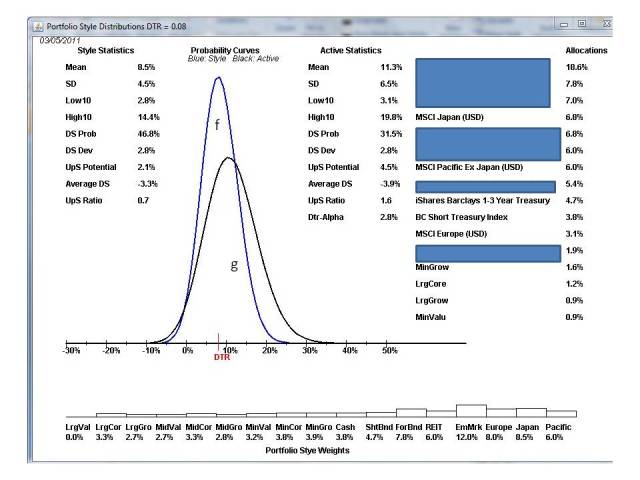
The solution is to have their actuary solve for the IRR that discounts the future payouts to the present value of the assets, including contributions, instead of assuming the actuarial return calculated when the plan was fully funded is still meaningful.  This would allow their consultant to construct a portfolio designed to maximize the potential to exceed that IRR relative to the risk of falling below the IRR.  We now call that IRR the Desired Target Return® or DTR®.

The figure below demonstrates how we would construct such a portfolio for an 8% DTR.  The symmetric distribution (f) consists of sll passive indexes while distribution (g) is a combination of active and passive managers.  The names of the active managers are blocked out.

Posted in Uncategorized | Tagged | Leave a comment