
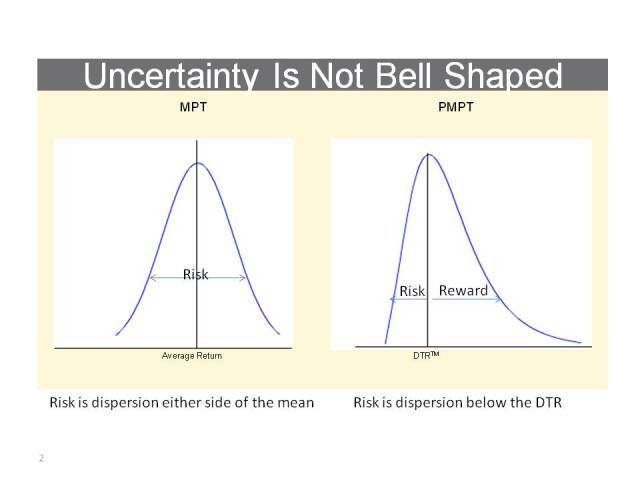
The focal point in MPT is the mean or average return. The focal point in PMPT is the Desired Target Return needed to accomplish the investor’s financial goal. The DTR is the missing link between the investor’s assets and future cash outflows. I originally called this the minimal acceptable return or MAR. Attorneys convinced me to change it to DTR since MAR might be interpreted as a guarantee of what an investor would receive “AT MINIMUM.”
We do live in a litigious society here in the states.
MPT measures risk as dispersion either side of the mean. PMPT measures risk as dispersion below the DTR. Dispersion above the DTR is the reward for taking on the risk of falling below the DTR. MPT measures the risk of not achieving the mean as standard deviation. PMPT measures the risk of not achieving one’s investment goal as deviations below the DTR. The underlying theory for PMPT was developed by Peter Fishburn when he was at the University of Pennsylvania.
I would like to start off this blog with a note from my friend and colleague, Hal Forsey:
Some Thoughts about Optimization
From Utility Theory
a) If the outcome from a choice of action is known with certainty then the optimal choice of action is the one with outcome of greatest utility.
b) If the probability distribution of the outcomes from a choice of action is known then the optimal choice of action is the one with the greatest expected utility of its outcomes.
c) If the probability distribution of the outcomes from a choice of action is only approximate then the action with the greatest expected utility may or may not be a reasonable choice of action.
Utility Theory applied to choosing an optimal portfolio
a) If the return from each possible investment is known with certainty then the optimal investment portfolio is a 100% allocation to the investment with the greatest return. This only assumes that the utility function is an increasing function of return.
b) If the joint probability of returns for the set of possible investments is known and if the utility function for portfolios with a given variance increases as the expected return increases then the optimal portfolio in on the mean-variance efficient frontier.
c) If the joint probability of returns is only approximate then portfolios on the efficient frontier may or may not be reasonable choices.
Comments about mathematically optimal solutions and real world problems
Optimal solutions to a mathematical problem are often on the boundary of possible solutions. This causes problems in applying mathematics to real world situation as the mathematical model used to describe the situation is often only an approximation. So the mathematical solutions to the model will often be extreme and since the model is only approximate the solution to the model may be far from optimal.
Think of the case in which the returns of the possible investments are thought to be known with certainty. The optimal solution might be a portfolio of 100% in oil futures. This is fine if the outcomes are actually known with certainty, but is extremely risky if this assumption is incorrect.
Even when it is only assumed that the joint probability of returns is known, limiting solutions to some efficient frontier will give extreme portfolios that may be far from optimal if the probability model does not fit reality. For example many probability models have thin tails that may lead to underestimating probabilities of large losses. This may, for example, lead to portfolios with too much weight in equities.
So maybe, the best one can do is to use the mathematics as only a guide in selecting portfolios.
 Post Modern Portfolio Theory (PMPT)
Honourable Mr. Sortino, I wish you well and I hope your valuable thoughts & academic input will spread across the world and ASAP into practice.
Thank you very much. I am working on a Generative AI model. Would you be interested in testing it?
You are welcome. Thank you for your interest in my life’s work!
A novice’s thoughts: All these mathematical models have implicit and expressed assuptions. The biggest problem is that some of these assumptions are vague, some are highly questionable, while others are plain wrong (not theoretically, but wrt. the real world). Our worst enemy are *hidden* implicit assumptions, i.e. those that slipped out of our attention (for whatever reason), in contrast to those implicit assumptions we can clearly identify. E.g. any study of historical data implicitely implies that the *observation* did not affect the data; yes, of course this is true. OTOH, it is well known that any trade, even small ones, affects the market (more generally: the observer affects the experiment).
You state the obvious in your two remarks. I am unfamiliar with your research. Please tell me about your innovations.
My point is: noone who derives a new strategy for investors includes in his study what happens when people start to follow that strategy. But the market is not static, a sufficiently large number of traders who follow the same strategy will affect the market in a way that was not expected in the original study.
But I’m not an academic, just an interested layman.
I did not mean to insult you. I should have said, your statement is obviously correct. There are 3 videos on the right side of my website that discuss my beliefs. I believe we live in a world of uncertainty There is no knowing what will happen in the future. My research attempts to describe that uncertainty in terms of a probability distribution. I reject the notion that the shape of that distribution is a bell shape, and therefore, all we need to know is the 1st and second moments of that distribution (the mean and standard deviation). More importantly, I believe that most investors do not know how to select a goal or how to achieve that goal. I do not believe the goal is to make money. Making money is how you achieve that goal. Most investors are trying to get from where they are financially, to where they want to be. That means they are able to estimate what payout they need at some specific time in the future. The internal rate of return that discounts that future payout to the present value of your assets, is what I call the Desired Target Return (DTR). I am retired and do not give investment advice. I simply comment on what I see going on in the world, particularly, when I believe the majority opinion is incorrect. I wish you well.
Frank Sortino
Eventually, I found an example that illustrates my concerns: Let’s have an inverted distribution of the ages of investors, i.e. what we have in the modern societies of developed countries. This distribution will not be smooth, e.g. there are bumps caused by temporary immigration (e.g. refugees, like what we’ve had recently here in europe), and other factors (e.g. “1-child-policy” in China caused a misrelation between men & women, who act differently, espc. in finance). Then any framework of how to enable fincancial laymen to retire in financial safety must consider the consequences: The demand for the different asset classes will not only depend on economic environment, but also vary by the distribution of the ages of the billions (!) of people distributed along a bumpy age-curve. This is no typo: IIUC e.g. China has no pension system; the children pay for their parents, that’s it.
This can lead to a problem: Poor Jenny wants to retire in an adverse economic environment, but she can’t find fairly priced asset classes to begin her landing glidepath from aggressive to defensive assets.
One of the implicit assumptions in financial theories is that the market will correct any mispricing & misbehaviour; but in some cases that can take quite longer than a decade(**). Given the problem outlined, it might be useful for the academic world to think about “useful & just” political regulations posed on the finacial system to address this.
** E.g. real estate can be misprices easily more than a decade. This is an asset where simple men can not diversify easily. Let’s say poor Jenny’s plan was to sell her house and she planned a “fair” price, but that’s going to be paid 12 years too late.
What you are asking for is beyond my capabilities at the present time. I developed a model at PRI some time ago that allowed one to input 3 scenarios, good market periods, bad market periods, and normal market periods periods. The user could assign probabilities to each and the model would construct a distribution of returns. It was not welcomed by financial institutions. I am working on something now that you may be interested in. I will let you know when I have something that I have tested.
Regards,
Frank